


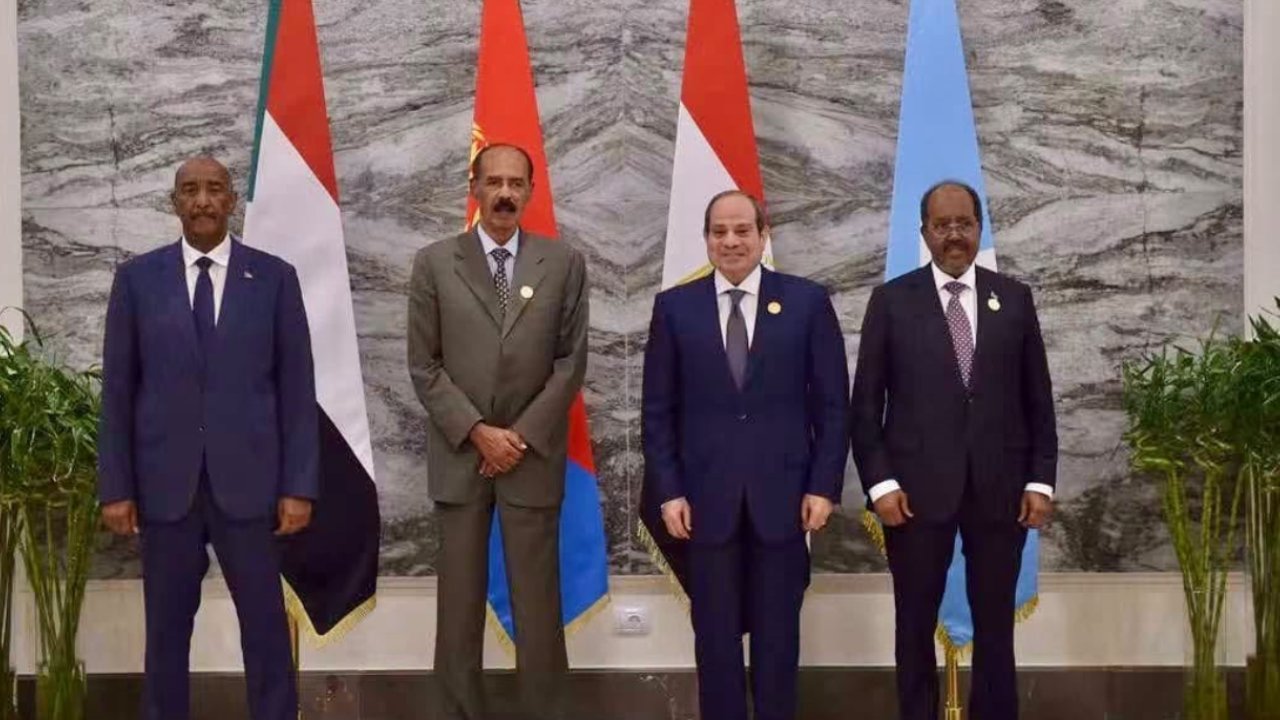
El Alamein, October 4, 2026 {HMC} The Government of Somalia has issued a statement following the quadrilateral summit held today in the Egyptian city of New El Alamein between the leaders of Egypt, Somalia, Sudan and Eritrea.
At the invitation of Egyptian President Abdel Fattah El-Sisi, President Isaias Afwerki of Eritrea, President Hassan Sheikh Mohamud of Somalia, and General Abdel Fattah al-Burhan, Chairman of Sudan’s Transitional Sovereignty Council, attended a quadrilateral summit in New El Alamein on October 4, 2026.
The leaders held extensive consultations in a spirit of brotherhood on regional and international issues, as well as ways to strengthen political, trade and economic cooperation among the four countries and enhance coordination and consultation between them.
The summit stressed the importance of upholding the fundamental principles of international law that form the basis for regional stability and cooperation.
These include respect for the sovereignty, stability and territorial integrity of countries in the region, good-neighborly relations, rejection of interference in the internal affairs of regional states under any pretext, support for national institutions, and the promotion of political and peaceful solutions to conflicts.
The leaders discussed coordinating joint efforts to promote regional stability, create an environment conducive to sustainable and shared development, and strengthen economic, trade and cultural relations.
They emphasized the importance of economic integration and connectivity, sustainable development, and stronger ties among the peoples of the participating countries, based on their common interests and shared future.
The summit addressed several key issues on which the participating leaders reached agreement:
a. Sudan: The leaders reaffirmed their support for the unity, sovereignty and territorial integrity of the Republic of Sudan and its national institutions.
They rejected the establishment of parallel institutions and called for the resumption of an inclusive political process led and owned by the Sudanese people. They also rejected any support for mercenaries.
b. Somalia: The leaders reaffirmed their support for the unity and sovereignty of the Federal Republic of Somalia and rejected any interference aimed at undermining Somalia’s unity and sovereignty, particularly the recognition of what was referred to as “Somaliland.”
c. Counterterrorism: The summit expressed support for Somalia’s efforts to combat terrorism and enable government institutions to extend their authority throughout the country.
The leaders called on regional and international partners to provide adequate, sustainable and predictable funding for the African Union Support and Stabilization Mission in Somalia (AUSSOM) to enable it to fulfill its mandate.
d. Red Sea: The leaders reaffirmed the principle of freedom of navigation for ships and stressed that the management and security of the Red Sea is primarily the responsibility of the countries bordering the Red Sea.
e. Nile River: The summit emphasized the importance of respecting international law governing transboundary rivers, including the Nile, particularly the principle of avoiding significant harm and the obligation to cooperate through prior notification, consultation and agreement.
The leaders rejected unilateral actions that could negatively affect the existing water uses of the two downstream Nile countries.
f. Continued Coordination: The four countries agreed to continue strengthening consultation, coordination and cooperation among them on regional and international issues.

