


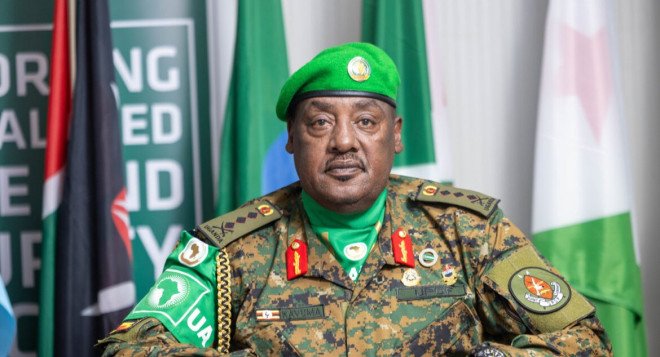
Wednesday, 16 Sep 2026 {HMC} The Commander of the African Union Support and Stabilization Mission in Somalia (AUSSOM), Lieutenant General Sam Kavuma, said Al-Shabaab has not captured any territory from Somali government or African Union forces since March last year.
In an exclusive interview, General Kavuma said AUSSOM forces had conducted operations that drove Al-Shabaab from several areas, including Sabiid, Bariire, Awdheegle, Mubaarak and Daarusalaam.
He said the group had lost territory, fighters, commanders and military leaders during the period, adding that these losses had affected the morale of its fighters.
However, Kavuma stressed that Al-Shabaab remains a major threat in Somalia because it is not only an armed group but also an ideology that requires a joint response from the Somali government, security forces and society.
“The guns alone cannot end the Al-Shabaab problem,” he said, emphasizing the need to address security, economic, food, health, environmental and social issues that contribute to insecurity.
The AUSSOM commander said the broader campaign against Al-Shabaab is led by the Somali government and its security forces, while the African Union mission provides support.
He said that although AUSSOM sometimes leads specific military operations, Somalia remains responsible for the overall direction of the campaign.
General Kavuma also said Somali forces need sufficient troops, logistics and equipment before full responsibility for national security can be transferred to them.
He identified three key capabilities that Somalia needs: adequate ground forces, air capabilities including surveillance and reconnaissance aircraft, and a capable naval force to protect the country’s coastline.
Kavuma also warned that reduced funding could affect AUSSOM operations. He said support from the United Nations Support Office in Somalia (UNSOS) currently covers approximately 85 percent of the mission’s operational requirements, and that losing this support without a replacement could have a significant impact on the mission.
He said a comprehensive security assessment should be conducted before troops withdraw from any strategic location, stressing that forces should not leave an area while Al-Shabaab still maintains significant operational capabilities there.
The AUSSOM commander said he did not have full knowledge of Al-Shabaab’s plans for the security transition, but believed the group could attempt to exploit any opportunities created by changes in the security environment.
He emphasized that Somali forces must develop sufficient capacity to fill areas vacated by AUSSOM, particularly in ground forces, logistics, air capabilities and naval security.
Kavuma said Somalia’s future will depend on the decisions and vision of its people, urging Somali stakeholders to resolve their differences through peaceful dialogue.

